What an operation actually is in C++
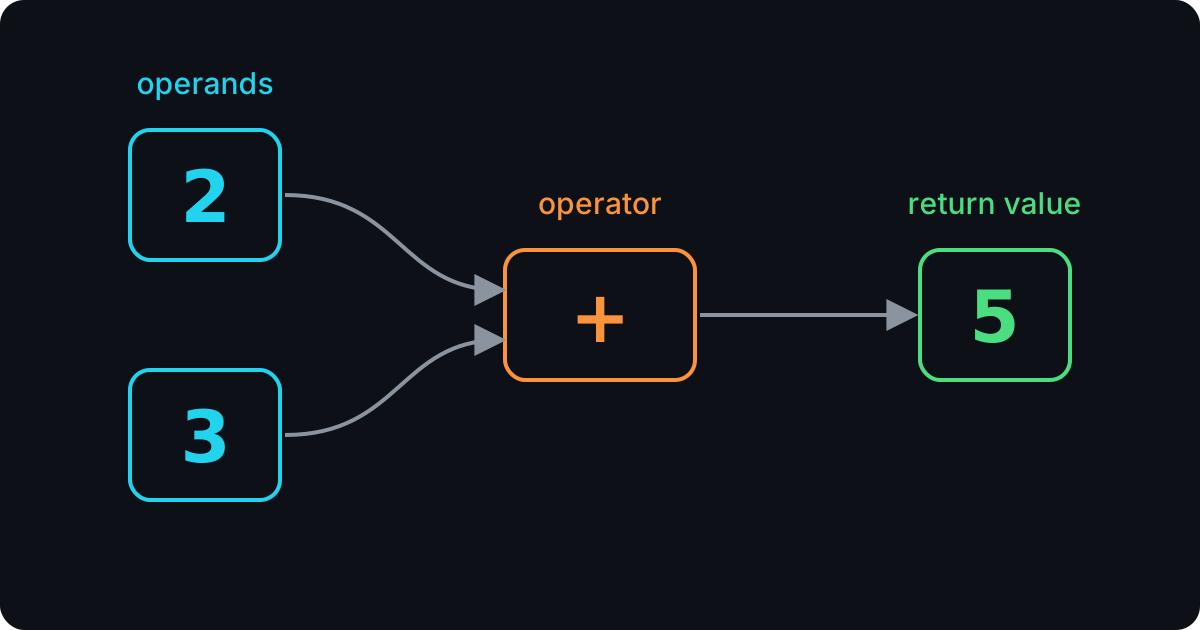
In maths, 2 + 3 is a calculation. In C++ it has a more precise name: an operation. This post is the written version of the first short in my C++ basics series, based on learncpp lesson 1.9.
Three roles in one operation
Most operations have the same three parts:
- Operands are the inputs. In
2 + 3these are2and3. - The operator says what to do with them. Here it is
+, which C++ callsoperator+. - The return value is the result of the operation:
5.
Operator + operands → return value.
The same holds when it does not look like maths. In std::cout << 5, the operator is << and the operands are std::cout and 5. Its return value is not the 5 you see on screen. operator<< hands back its left operand, std::cout, which is why std::cout << 5 << '\n' can be chained. The printing itself is a side effect, and I will get to that in a later post.
(“Most” because there are exceptions: throw takes no operands, and delete returns nothing. That is the next post.)
The return value has a type, too
I wrote a small macro to make this visible. #expr turns the expression into text, and decltype(expr) asks the compiler which type the result has:
#include <iostream>
#include <string>
#include <type_traits>

template <typename T>
std::string name()
{
    if (std::is_same_v<T, int>) return "int";
    if (std::is_same_v<T, double>) return "double";
    return "?";
}

#define SHOW(expr) \
    std::cout << #expr << " : " << name<decltype(expr)>() << " = " << (expr) << '\n'

int main()
{
    SHOW(2 + 3);
    SHOW(2 + 3.0);
    return 0;
}
2 + 3 : int = 5
2 + 3.0 : double = 5Same operator, same visible number, different return type. The type of the result depends on the operands. That small difference is where C++ gets interesting, and I will come back to it with a whole post on integer promotion.
Literal or variable
An operand can come from two places. Compare these two snippets:
#include <iostream>

int main()
{
    std::cout << 5 << '\n';
    return 0;
}
#include <iostream>
int main()
{
int x { 5 };
std::cout << x << '\n';
return 0;
}Both print 5. I compiled and ran both (and the macro above) with g++ -std=c++17 -Wall -Wextra to be sure.
The difference is where the operand comes from:
5is a literal, a fixed value written directly into the source code. It always means 5.xis a variable, a named object. Its value can change later.
Literals can be operands, just like variables. Same output, different origin.
What’s next
2 + 3 has two operands, but not every operator works that way. Next time: how many operands can an operator have?